

#01 Animal Instinct: Why We Keep Coming Back to Animal Print
A take on power, pelts and polyester.

You’re reading № 01 of The Taste Archive — a fortnightly dissection of one very specific design obsession.
Somewhere in storage there is a leopard print jacket, size aged-six, that predated the animal print trend cycle by approximately two decades. It was my most prized possession, one that had belonged to an older, considerably cooler cousin, worn with full conviction regardless of occasion, weather, or social consequence.
That jacket must have been lurking somewhere in the back of my mind, because for the past two weeks my Pinterest has been nothing short of a wildlife documentary. And not for the first time. Leopard print seems to resurface whenever things feel… uncertain.
And so it feels only right to open the first edition of Pinned where I began: obsessed with leopard print at the ripe age of six.
Apparently not much has changed since.
If this is the first time you’re reading me, hi, welcome! The madness that’s about to follow might make more sense if you read Pinned’s introduction first, you can find it on my Substack.
The Current Context
Trend reporters categorise leopard print as a recession indicator.
Being both loud and easy to access, leopard print sits somewhere adjacent to the so-called “lipstick effect” — the idea that when money tightens, people abandon big-ticket spending in favour of smaller, more tangible indulgences (often, quite literally, lipstick). It’s not quite the same thing, but it's the art of the affordable signal: you can't buy the lifestyle, but you can buy the suggestion of it. And so leopard print is popular during recessions not because people want comfort, but because they want to look like the recession isn’t happening to them.
Let’s zoom out for a second.
We’ve been living under “any‑day‑now” recession forecasts since around 2022, and leopard has obligingly reappeared on cue. By 2023–24 it was back on the runways – SS24 and AW24 shows at houses like Celine, Michael Kors, Dolce & Gabbana and Jacquemus pushed it hard – before it filtered down into the high street and, eventually, the leopard Sambas on everyone’s feet.
Which is just the contemporary chapter in animal print'’s much longer story.
The History
I have a good friend who studied biology at university, and whenever we inevitably find ourselves discussing life and world issues, he brings it back to our hunter-gatherer instincts, stripping every problem down to basic human nature.
So indulge me while I try to do the same.
Back in prehistoric times, the strongest member of a tribe was the hunter — the person who ensured safety against predators, who was the strongest, fiercest, and most capable, unbeatable against the most vicious of animals. They held power because, ultimately, they were the ones keeping the rest alive against threat1. Wearing their pelt after defeating them was a trophy of victory, of strength, power.
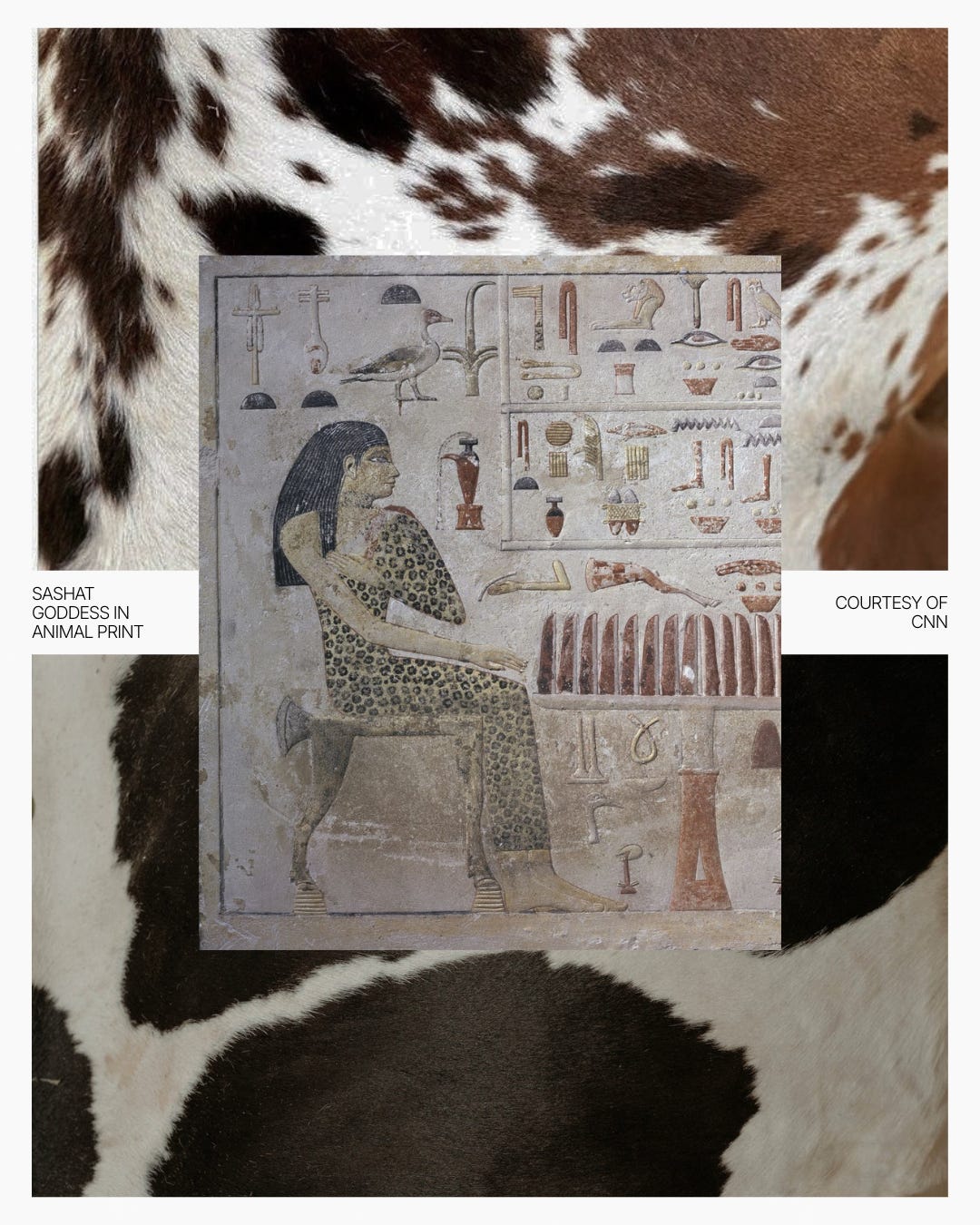
It was that same power that the Egyptians adopted several centuries later with depictions of their Goddess Seshat, carved into a corner of the Karnak Temple Complex in Luxor2. Associated with writing, record-keeping, and architecture, Seshat’s dominance wasn’t of brute force like the hunter’s but of intellect. The Egyptians believed that wearing an animal’s skin transferred its power to you, and Seshat wore the leopard's pelt not to prove she could kill it, but to show she had already conquered something far harder.
This power and dominance translated across cultures and centuries, guarded jealously by those at the top. Roman emperor Honorius banned his court from wearing fur to ensure its exclusivity3. In England, Henry VIII forbade commoners from wearing certain furs or patterns4, reserving those associations for royalty only. In 13th century France, a Royal Ordinance made ermine fur exclusive to the royal family and aristocracy5.
And then the 1960s happened, and it all went to shit.
Mass production, Hollywood, and synthetic fabric brought leopard print to the high street, and with it, the collapse of everything those in power had tried to protect.
I'm not suggesting people wear leopard print today to showcase brute force, the way the hunters did. Nor that they wear it because it's something only royalty can access, the way Honorius intended. But the power it connotes bears all of that history, consciously or not — and has morphed, over centuries, into something more personal: confidence.
The Mistake
For all my affection for the print, I'm under no illusions about how quickly it can go wrong. To cross the dreaded line from bold to tacky. Animal print is loud, and like anything visually striking, push it too far and people don’t see you, they just see the print.
So here’s a few (self proclaimed) rules of usage.
The further the print strays from the original, the closer it gets to costume.
If you’re wearing leopard print but the print has been applied to sherpa, it’s going to look cheap. Same thing goes for snake skin that looks plastic-like or too shiny.
The print is loud enough on its own.
Animal print is great, but it can quickly become too much, too quickly. It looks more considered when used as a highlighting piece, not a neutral.
Cow print is black and white. Not pink, or blue, or red.
Nobody expects you to wear a real cow… but that doesn't mean the cow should be neon.
The Application
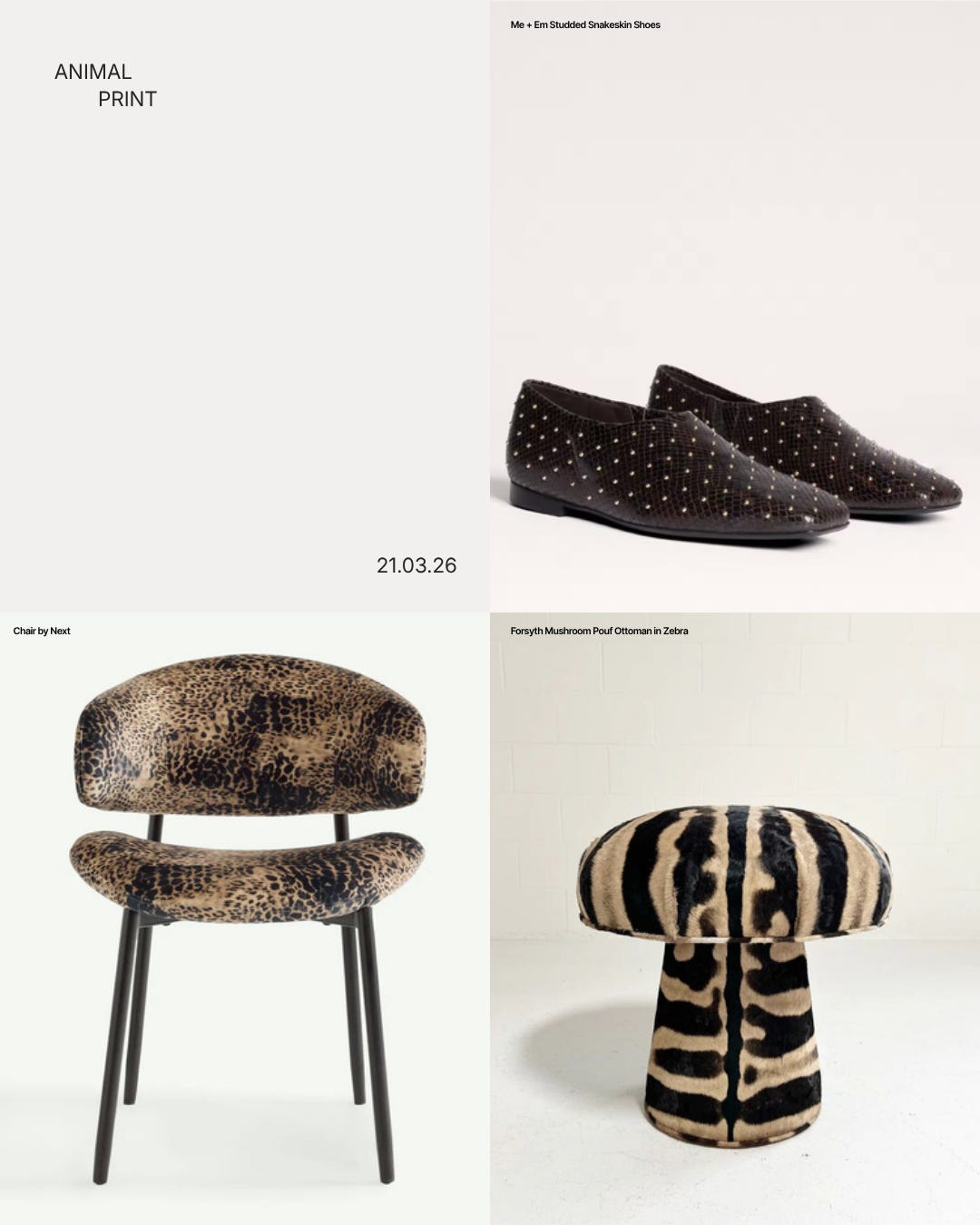
I suppose now would be a good time to point out that most of what lies in my CRAP board is not actual leopard print, but contemporary derivatives of it (Bambi fur, snake skin, horse manes…). They carry a slightly different connotation, a softer alternative to the full feline fantasy, a kind of doe‑eyed delicacy compared with the brasher cheetah and leopard crowd.
But even within this family of not‑quite‑leopard, the moods are wildly different. In the interests of simplification, I’ve started thinking of them as a kind of animal‑print Myers‑Briggs: snakeskin as sleek, luxe and a bit dangerous; cow print as Western‑coded and weirdly neutral – a graphic splurge that behaves almost like a black‑and‑white check; and zebra as fresh, edgy.
The zoo of prints apparently work best on their own, or combined with smooth, contemporary materials like steel or solid, chunky pieces of timber. Equally, I seem to favour its use when paired with neutral colours, not bold and bright ones (shocker to no-one that knows me and my love for neutrals).


I started this post thinking I was writing about a trend on a Pinterest board. I ended it realising I was writing about something a bit more poetic than that — the very human desire to borrow power from something wilder than yourself.
I suppose the jacket made more sense at six than I gave it credit for.
Widely documented across hunter-gatherer cultures globally; see Sportsmen’s Alliance, citing James Swan, In Defense of Hunting.
Wikipedia, Seshat; World History Encyclopedia, Seshat (2016); Timeless Myths, Seshat.
Honorius issued a decree in 397 AD forbidding his court from wearing fur. The motivation recorded is economic — protecting its trading value — though the effect was the same: fur became a marker of exclusivity by scarcity. National Museum of Denmark, Fur in Antiquity.
Henry VIII passed four Acts of Apparel during his reign (1510, 1514, 1515, 1533), reserving specific luxury materials — sable fur, cloth of gold, purple silk — for the nobility and royal family respectively. Leopard fur is not named explicitly in the surviving documents; the broader point stands that exotic animal materials were legally class-coded. A Bit of Henry Love, Sumptuary Laws under Henry VIII (2012); Tudor History, Sumptuary Laws.
In 13th-century France, sumptuary laws restricted luxury furs to the nobility. Ermine became the defining royal fur across European monarchies — its scarcity (sourced from stoats in Scandinavia and Russia) reinforcing its status. Grokipedia, Ermine (heraldry); National Geographic, A surprising must-have for European monarchs? Weasels (2024).
I’m also a forever leopard lover. It’s a neutral! Such a great read.